12 Common Flat Roof Problems in Brooklyn & How to Fix Them
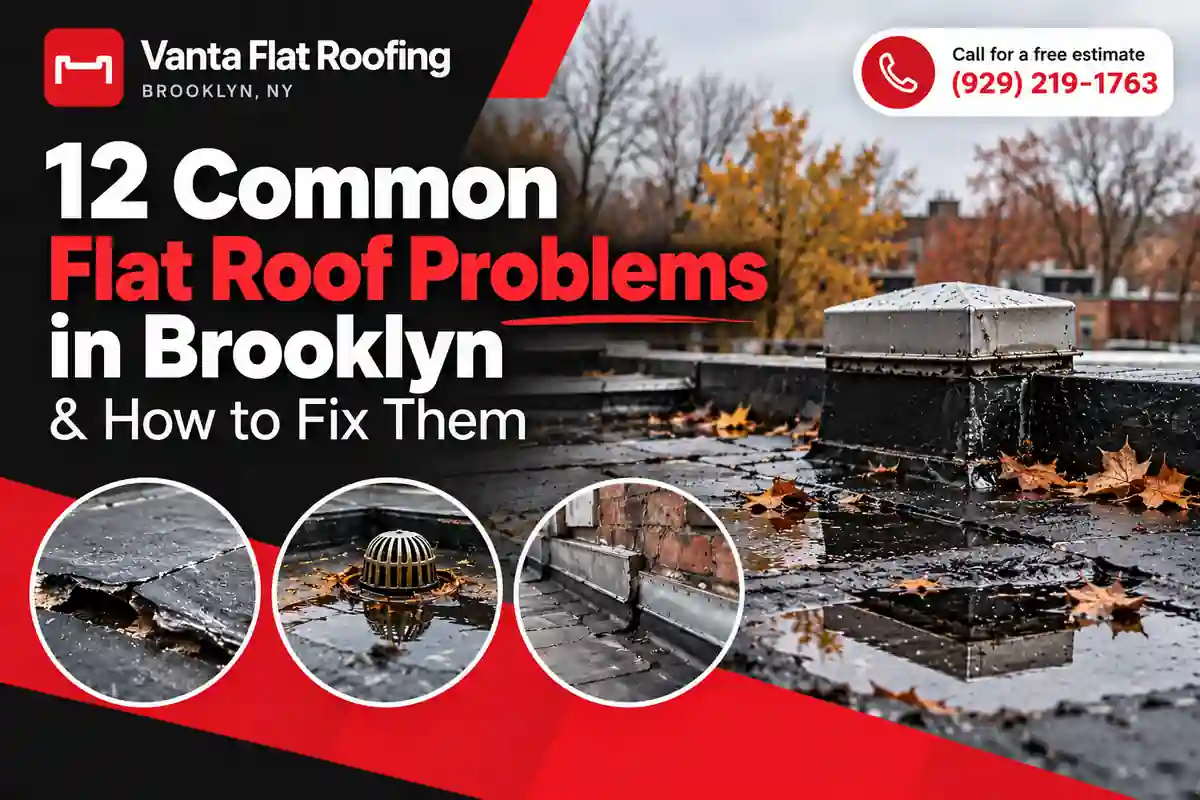
Flat roofs cover most of Brooklyn: brownstones, rowhouses, walk-ups, corner stores and warehouses. They work well when they are built and maintained properly, but they don’t forgive neglect. Water doesn’t run off a flat roof the way it does off a sloped one, so small problems grow quickly.
Brooklyn’s weather makes it harder. Summer sun bakes the membrane, freeze-thaw winters open up cracks and seams, and nor’easters drive rain sideways into every weak joint. Below are the twelve problems we see most often on Brooklyn roofs, how to spot each one, why it happens, and what actually fixes it.
1. Ponding water
- What you’ll see
- Puddles still on the roof 48 hours after rain, or dark rings and dirt lines where water has dried.
- Why it happens
- The roof has lost its slope. Decks sag with age, insulation compresses under foot traffic, and drains end up sitting higher than the roof around them.
- The fix
- Clear the drain first, since that is sometimes enough. If water still sits, the low area is built up with tapered insulation or a small cricket that steers water toward the drain.
2. Clogged drains and scuppers
- What you’ll see
- Water backing up around the drain, overflowing scuppers, and leaves or seeds piled at the low points.
- Why it happens
- Brooklyn’s street trees drop leaves, seeds and twigs onto roofs every fall, and a single blocked drain can flood a whole section of roof.
- The fix
- Clear the drain, add a strainer, and check the seal around the drain bowl, which often fails once water has backed up around it.
3. Failed flashing at parapet walls
- What you’ll see
- Cracked, loose or lifted flashing where the roof meets a wall, and stains on the wall below the parapet.
- Why it happens
- Flashing seals the joint between the roof and the wall, and that joint moves every time the building heats and cools. On brownstones with shared parapets on both sides, it is the first place to fail.
- The fix
- Reseal or rebuild the flashing and check the coping and brick above it. Water that gets behind the masonry will run in under even brand-new flashing.
4. Open or lifted seams
- What you’ll see
- Sheet edges lifting where two pieces of membrane overlap, or gaps you can slide a finger into.
- Why it happens
- Seam tape and adhesive weaken with age and temperature swings, and seams that were welded too cold or too fast during installation open up years later.
- The fix
- Seams are cleaned and re-taped on EPDM, or re-welded with hot air on TPO and PVC, then probed to make sure the bond is continuous.
5. Blisters and bubbles
- What you’ll see
- Raised, soft bubbles in the surface, most often on modified bitumen and built-up (tar and gravel) roofs.
- Why it happens
- Moisture or air trapped between layers expands in the summer sun. Many blisters start on install day, when layers weren’t fully bonded.
- The fix
- A small, intact blister can be watched. One that cracks or grows is cut out, dried and patched with matching material.
6. Cracks, splits and alligatoring
- What you’ll see
- Fine surface cracks, deeper splits, or a pattern that looks like alligator skin on older asphalt roofs.
- Why it happens
- Years of UV exposure dry out the surface, and Brooklyn’s freeze-thaw winters push water into the cracks and open them wider every season.
- The fix
- Deep splits are cut back and patched. Surface cracking on a roof that is still dry underneath is a good candidate for a silicone or acrylic coating.
7. Punctures and foot-traffic damage
- What you’ll see
- Small holes, cuts or scuffs near HVAC units, satellite dishes, the roof hatch or a path people use to reach a roof deck.
- Why it happens
- Dropped tools, contractors servicing equipment, furniture on an unprotected roof, and fallen branches.
- The fix
- A matching patch over the damage, and walkway pads on the routes people use so it doesn’t happen again.
8. EPDM shrinkage
- What you’ll see
- Black rubber pulled tight across corners and away from walls, sometimes lifting the flashing with it.
- Why it happens
- EPDM shrinks slightly over the years. On older rubber roofs that were glued only at the edges, the pull concentrates at the walls.
- The fix
- New strips of rubber are added at the walls so the membrane is no longer stretched, and the flashing is reattached.
9. Wind damage and membrane uplift
- What you’ll see
- Membrane billowing on windy days, loose edges, missing metal edge trim, or wrinkles that weren’t there before.
- Why it happens
- Nor’easters and strong gusts get under loose edges and lift the membrane. Once air is under the sheet, every storm pulls it further.
- The fix
- The edges are re-secured with new fasteners and edge metal, and any torn or stretched membrane is patched or replaced.
10. Wet insulation and soft spots
- What you’ll see
- Spongy or soft areas underfoot, and a roof that keeps leaking after repairs.
- Why it happens
- Water that got in through an earlier problem soaks into the insulation and stays there. Wet insulation loses its value, adds weight and keeps feeding leaks.
- The fix
- The wet section is cut out and replaced with dry insulation, then the roof is patched over it. Large wet areas usually mean it is time to replace.
11. Roof hatch, skylight and penetration leaks
- What you’ll see
- Water around roof hatches, skylights, bulkheads, vent pipes or plumbing stacks.
- Why it happens
- Every opening in a roof is a joint, and the seals and pipe boots around them dry out and crack long before the rest of the roof.
- The fix
- Each opening gets new flashing or a pre-formed boot made for that material, sealed into the membrane around it.
12. Old patches and the wrong repair materials
- What you’ll see
- Tar smeared over rubber or white roofs, layers of caulk at the same spot, or patches that don’t match the roof.
- Why it happens
- Quick fixes with roof cement or the wrong sealant don’t bond to modern membranes. Asphalt products even break down PVC and TPO.
- The fix
- The old patch is removed down to clean membrane and the area is repaired with the same material as the roof.
How to check your flat roof safely
Only go up in dry weather and only if you have a safe way onto the roof. From the roof hatch, look for:
- Water still standing two days after rain
- Bubbles, cracks or bare spots in the surface
- Lifted seams, loose edges or flashing pulling away from walls
- Leaves and debris in or around drains and scuppers
- Soft spots underfoot, a sign of wet insulation: step off and call a roofer
If you can’t get onto the roof safely, a roofer can inspect it for you and send photos of everything they find.
Repair or replace?
Almost every problem on this list is a repair when it is caught early. A roof usually needs replacing when several of these problems show up at once, the roof is more than 20 years old, or the insulation underneath is wet across large areas. In that case, patching keeps costing money without solving the problem. Ask your roofer for photos of the problem areas and a written price for both options, so you can compare them side by side.
How to prevent flat roof problems
- Clear drains and scuppers every fall after the leaves drop, and again in spring.
- Have the roof inspected once a year and after any major storm.
- Keep foot traffic on walkway pads, and protect the roof when equipment is serviced.
- Fix lifted seams and flashing gaps as soon as they appear.
- Repair with the same material as the roof, never with tar or caulk on a modern membrane.
- Consider a reflective coating on an older roof that is still dry underneath.
Common flat roof problems: FAQs
What is the most common flat roof problem in Brooklyn?
Failed flashing at parapet walls and clogged drains cause more trouble than anything else we see. Both are joints or low points where water collects, and both are easy to miss until the damage spreads.
Is ponding water on a flat roof normal?
Small puddles that dry within 48 hours are normal. Water that stays longer means the roof isn’t draining properly and should be checked before it wears out the membrane.
How often should a flat roof be inspected?
Once a year, ideally in the fall after the leaves drop, and again after any major storm. Catching a lifted seam or a blocked drain early keeps the repair small.
Can I fix a flat roof problem myself?
Clearing leaves from a drain is a safe DIY job. Patching membranes and flashing is not: the wrong material or sealant often traps water and makes the next repair harder and more expensive.
Seeing any of these on your roof?
Our team handles flat roof repair in Brooklyn every day, with a free inspection and a written price before any work starts.